https://atcoder.jp/contests/abc281/tasks/abc281_g
The desired graphs are equivalent to simple connected undirect graph such that $dis[1]=0,dis[n]=\max,0<dis[i]<\max$
Then consider a bfs tree:
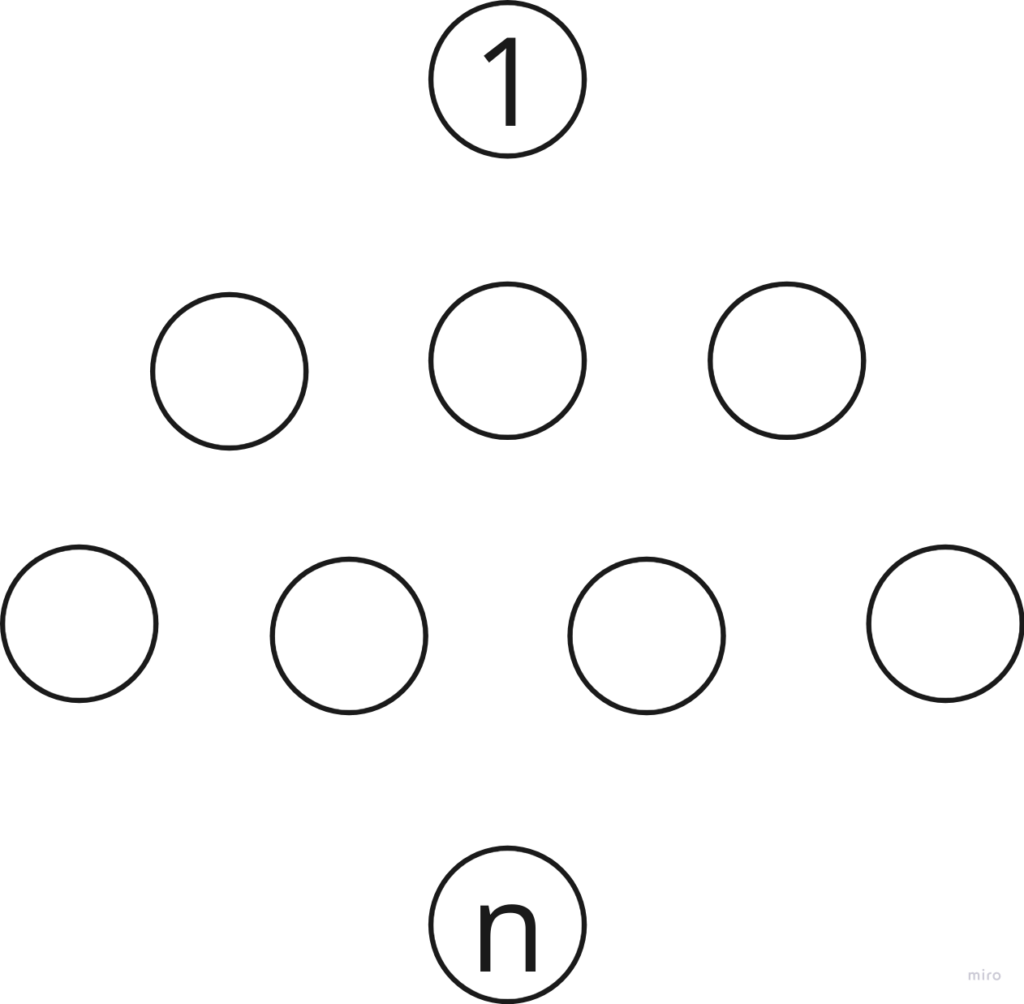
The vertices at the $i$-th level represents $dis=i$, a bfs tree can restore many graphs, just met the following conditions:
- Each vertex has edge with at least one vertex in the previous level
- Edges between vertices at the same level are optional
Let $dp[i][j]$ represents the number of graphs consisting of $i$ vertices and last level has $j$ vertices
$dp[1][1]=1$, $dp[i][j]$ can be transitioned by all $dp[i-j][k]$
Then consider the count in a transition, let $cur$ = the number of vertices in the last level, $last$ = the number of vertices in the penultimate level:
- Each vertex has edge with at least one vertex in the previous level. For each vertex there are $2^{last}-1$ choices, total $(2^{last}-1)^{cur}$
- Edges between vertices at the same level are optional. Total $\binom{cur}{2}$
- The graph is numbered, where the indices of the previous $i-cur$ vertices have already been determined, and the index of the vertex $n$ has also been determined. So choose $cur$ vertices among $n-(i-cur)-1$ vertices: $\binom{n-i+cur-1}{cur}$. The transition of the last level is an exception, because the vertex $n$ is also included, so the calculation formula of the last level is $\binom{n-i+cur}{cur}$
Multiply these counts:
$$dp[i][cur]=\sum(dp[i-cur][last]\times (2^{last}-1)^{cur}\times \binom{cur}{2}\times \binom{n-i+cur-1}{cur})$$
$$dp[n][cur]=\sum(dp[i-cur][last]\times (2^{last}-1)^{cur}\times \binom{cur}{2}\times \binom{n-i+cur}{cur})$$
Answer is $dp[n][1]$
// compile: g++ -o data data.cpp -O3 -std=gnu++20 -Wall -Wextra -Wshadow -D_GLIBCXX_ASSERTIONS -ggdb3 -fmax-errors=2 -DLOCAL
// run: ./data < data.in
#include <bits/stdc++.h>
using namespace std;
#pragma GCC optimize("O3,unroll-loops")
#pragma GCC target("avx2,bmi,bmi2,lzcnt,popcnt")
#ifdef LOCAL
#include <debug/codeforces.h>
#define debug(x...) {_variables(#x);_print(x);}
#else
#define debug(x...)
#endif
template<typename...Args> void print_(Args...args){((cout<<args<<" "),...)<<endl;}
#define rep(i,a,b) for(int i=(a);i<(int)(b);++i)
#define sz(v) ((int)(v).size())
#define print(...) print_(__VA_ARGS__);
#define INTMAX (int)(9223372036854775807)
#define INTINF (int)(1152921504606846976)
#define int long long
#define MAXN 1010

namespace atcoder{namespace internal{template<class T>using is_integral=typename std::is_integral<T>;template<class T>using is_signed_int=typename std::conditional<is_integral<T>::value&&std::is_signed<T>::value,std::true_type,std::false_type>::type;template<class T>using is_unsigned_int=typename std::conditional<is_integral<T>::value&&std::is_unsigned<T>::value,std::true_type,std::false_type>::type;template<class T>using to_unsigned=typename std::conditional<is_signed_int<T>::value,std::make_unsigned<T>,std::common_type<T>>::type;template<class T>using is_signed_int_t=std::enable_if_t<is_signed_int<T>::value>;template<class T>using is_unsigned_int_t=std::enable_if_t<is_unsigned_int<T>::value>;template <class T>using to_unsigned_t=typename to_unsigned<T>::type;constexpr int safe_mod(int x,int m){x%=m;if(x<0)x+=m;return x;}struct barrett{unsigned int _m;unsigned int im;explicit barrett(unsigned int m):_m(m),im((unsigned int)(-1)/m+1){}unsigned int umod()const{return _m;}unsigned int mul(unsigned int a,unsigned int b)const{unsigned int z=a;z*=b;unsigned int x=(unsigned int)(((unsigned __int128)(z)*im)>>64);unsigned int y=x*_m;return(unsigned int)(z-y+(z<y?_m:0));}};constexpr std::pair<int,int> inv_gcd(int a,int b){a=safe_mod(a,b);if(a==0){return{b,0};}int s=b,t=a;int m0=0,m1=1;while(t){int u=s/t;s-=t*u;m0-=m1*u;auto tmp=s;s=t;t=tmp;tmp=m0;m0=m1;m1=tmp;}if(m0<0)m0+=b/s;return{s,m0};}constexpr int pow_mod_constexpr(int x,int n,int m){if(m==1)return 0;unsigned int _m=(unsigned int)(m);unsigned int r=1;unsigned int y=safe_mod(x,m);while(n){if(n&1)r=(r*y)% _m;y=(y*y)% _m;n>>=1;}return r;}constexpr bool is_prime_constexpr(int n){if(n<=1)return false;if(n==2||n==7||n==61)return true;if(n%2==0){return false;}int d=n-1;while(d%2==0)d/=2;constexpr int bases[3]={2,7,61};for(int a:bases){int t=d;int y=pow_mod_constexpr(a,t,n);while(t!=n-1&&y!=1&&y!=n-1){y=y*y%n;t<<=1;}if(y!=n-1&&t%2==0){return false;}}return true;}template <int n>constexpr bool is_prime=is_prime_constexpr(n);struct modint_base{};struct static_modint_base:modint_base{};template <class T>using is_modint=std::is_base_of<modint_base,T>;template <class T>using is_modint_t=std::enable_if_t<is_modint<T>::value>;}template <int m,std::enable_if_t<(1<=m)>* =nullptr>struct static_modint:internal::static_modint_base{using mint=static_modint;public:static constexpr int mod(){return m;}static mint raw(int v){mint x;x._v=v;return x;}static_modint():_v(0){}template<class T,internal::is_signed_int_t<T>* =nullptr>static_modint(T v){int x=(int)(v %(int)(umod()));if(x<0)x+=umod();_v=(unsigned int)(x);}template <class T,internal::is_unsigned_int_t<T>* =nullptr>static_modint(T v){_v=(unsigned int)(v%umod());}unsigned int val()const{return _v;}mint&operator++(){_v++;if(_v==umod())_v=0;return *this;}mint&operator--(){if(_v==0)_v=umod();_v--;return *this;}mint operator++(int32_t){mint result=*this;++*this;return result;}mint operator--(int32_t){mint result=*this;--*this;return result;}mint&operator+=(const mint&rhs){_v+=rhs._v;if(_v>=umod())_v-=umod();return *this;}mint&operator-=(const mint&rhs){_v-=rhs._v;if(_v>=umod())_v+=umod();return *this;}mint&operator*=(const mint&rhs){unsigned int z=_v;z*=rhs._v;_v=(unsigned int)(z%umod());return *this;}mint&operator/=(const mint&rhs){return *this=*this*rhs.inv();}
mint operator+()const{return *this;}mint operator-()const{return mint()-*this;}mint pow(int n)const{assert(0<=n);mint x=*this,r=1;while(n){if(n&1)r*=x;x*=x;n>>=1;}return r;}mint inv()const{if(prime){assert(_v);return pow(umod()-2);}else{auto eg=internal::inv_gcd(_v,m);assert(eg.first==1);return eg.second;}}friend mint operator+(const mint&lhs,const mint&rhs){return mint(lhs)+=rhs;}friend mint operator-(const mint&lhs,const mint&rhs){return mint(lhs)-=rhs;}friend mint operator*(const mint&lhs,const mint&rhs){return mint(lhs)*=rhs;}friend mint operator/(const mint&lhs,const mint&rhs){return mint(lhs)/=rhs;}friend bool operator==(const mint&lhs,const mint&rhs){return lhs._v==rhs._v;}friend bool operator!=(const mint&lhs,const mint&rhs){return lhs._v!=rhs._v;}private:unsigned int _v;static constexpr unsigned int umod(){return m;}static constexpr bool prime=internal::is_prime<m>;};template<int id>struct dynamic_modint:internal::modint_base{using mint=dynamic_modint;public:static int mod(){ return(int)(bt.umod()); }static void set_mod(int m){assert(1<=m);bt=internal::barrett(m);}static mint raw(int v){mint x;x._v=v;return x;}dynamic_modint():_v(0){}template<class T,internal::is_signed_int_t<T>* =nullptr>dynamic_modint(T v){int x=(int)(v %(int)(mod()));if(x<0)x+=mod();_v=(unsigned int)(x);}template<class T,internal::is_unsigned_int_t<T>* =nullptr>dynamic_modint(T v){_v=(unsigned int)(v%mod());}unsigned int val()const{return _v;}mint&operator++(){_v++;if(_v==umod())_v=0;return *this;}mint&operator--(){if(_v==0)_v=umod();_v--;return *this;}mint operator++(int32_t){mint result=*this;++*this;return result;}mint operator--(int32_t){mint result=*this;--*this;return result;}mint&operator+=(const mint&rhs){_v+=rhs._v;if(_v>=umod()){_v-=umod();}return *this;}mint&operator-=(const mint&rhs){_v+=mod()-rhs._v;if(_v>=umod())_v-=umod();return *this;}mint&operator*=(const mint&rhs){_v=bt.mul(_v,rhs._v);return *this;}mint&operator/=(const mint&rhs){return *this=*this*rhs.inv();}mint operator+()const{return *this;}mint operator-()const{return mint()- *this;}mint pow(int n)const{assert(0<=n);mint x=*this,r=1;while(n){if(n&1)r*=x;x*=x;n>>=1;}return r;}mint inv()const{auto eg=internal::inv_gcd(_v,mod());assert(eg.first==1);return eg.second;}friend mint operator+(const mint&lhs,const mint&rhs){return mint(lhs)+=rhs;}friend mint operator-(const mint&lhs,const mint&rhs){return mint(lhs)-=rhs;}friend mint operator*(const mint&lhs,const mint&rhs){return mint(lhs)*=rhs;}friend mint operator/(const mint&lhs,const mint&rhs){return mint(lhs)/=rhs;}friend bool operator==(const mint&lhs,const mint&rhs){return lhs._v==rhs._v;}friend bool operator!=(const mint&lhs,const mint&rhs){return lhs._v!=rhs._v;}private:unsigned int _v;static internal::barrett bt;static unsigned int umod(){ return bt.umod(); }};template<int id>internal::barrett dynamic_modint<id>::bt(998244353);using modint998244353=static_modint<998244353>;using modint1000000007=static_modint<1000000007>;using modint=dynamic_modint<-1>;namespace internal{template<class T>using is_static_modint=std::is_base_of<internal::static_modint_base,T>;template<class T>using is_static_modint_t=std::enable_if_t<is_static_modint<T>::value>;template<class> struct is_dynamic_modint:public std::false_type{};template<int id>struct is_dynamic_modint<dynamic_modint<id>>:public std::true_type{};template<class T>using is_dynamic_modint_t=std::enable_if_t<is_dynamic_modint<T>::value>;}}

using mint = atcoder::modint;

mint C[MAXN][MAXN];
mint dp[MAXN][MAXN];
mint pow2[MAXN*MAXN];
mint powpow[MAXN][MAXN];

int32_t main() {
    ios::sync_with_stdio(false); cin.tie(nullptr); cout.tie(nullptr);

    int n, M; cin >> n >> M;
    mint::set_mod(M);
    rep(i, 0, n+1) {
        C[i][0] = 1;
        rep(j, 1, i+1) C[i][j] = C[i-1][j-1] + C[i-1][j];
    }
    pow2[0] = 1; rep(i, 1, n*n+1) pow2[i] = pow2[i-1] * 2;
    rep(i, 1, n+1) rep(j, 1, n+1) powpow[i][j] = mint(pow2[i] - 1).pow(j);
    dp[1][1] = 1;
    rep(i, 2, n+1) {
        rep(j, 1, i+1) {
            rep(k, 1, i-j+1) {
                dp[i][j] = (dp[i][j] + dp[i-j][k] * powpow[k][j] * pow2[C[j][2].val()] * ((i==n) ? C[n-(i-j)][j] : C[n-(i-j)-1][j]));
            }
        }
    }
    cout << dp[n][1].val() << endl;

    return 0;
}
The size of the data for this question is very suspicious($n=500$), $O(n^3)$ algorithm seems to be difficult to pass. When encountering counting problems like this, try to layer the graph, bfs tree is a good entry point. Verify the correctness of the state transition function through some small data.
Registering here was a breeze and the welcome bonus arrived with a cheerful note rather than fine print traps. The gem themed slots bring back childhood nostalgia while still offering modern payouts. I always start my gaming sessions here. jiligemloginregister
I joined a few months back and the security measures give me total peace of mind. My payment details are always safe and the two factor authentication adds an extra layer of protection. The game library is well organized and I can find my favourites in seconds. A genuinely enjoyable experience. inmpl999
Locating a platform that actually pays out quickly in the Philippines used to be a real struggle for me. This one changed everything since my first withdrawal landed in my account in record time. The mobile version is super responsive and the game selection covers all my favorite genres. phpesowin